
Industrial performance depends on turning operating context into clear decisions. Most industrial environments already have the signals: flow, pressure, temperature, vibration, chemistry, alarms, events. What they lack is software that turns that telemetry into timely, usable operational judgment.
The burden stays with the operator, the production engineer, the maintenance lead. They stitch together alarm history, live trends, recent work orders, operating procedures, handover notes, and whatever tribal knowledge still lives in the room. Performance gets won or lost in that manual synthesis step.
The next layer in industrial software interprets operating context and helps the site act on it. It explains what changed, what it likely means, what has happened before, and what should happen next. In practice: fewer manual handoffs, faster troubleshooting, tighter process control, more consistent decisions across shifts.
That is what we are building at Puffstack. Corintel sits on top of existing SCADA infrastructure, reads production data through standard industrial protocols (OPC-UA, MQTT, Modbus), and delivers optimization recommendations that operators can accept, modify, or reject. Every recommendation includes its reasoning and its source data with a context layer learning in the background. The operator stays in control.
The recurring pattern across industrial operations is the same. The data to make better decisions is already being collected. The software to interpret it and recommend action does not exist in most control rooms. Here is where that pattern shows up most clearly.
Chemical treatment
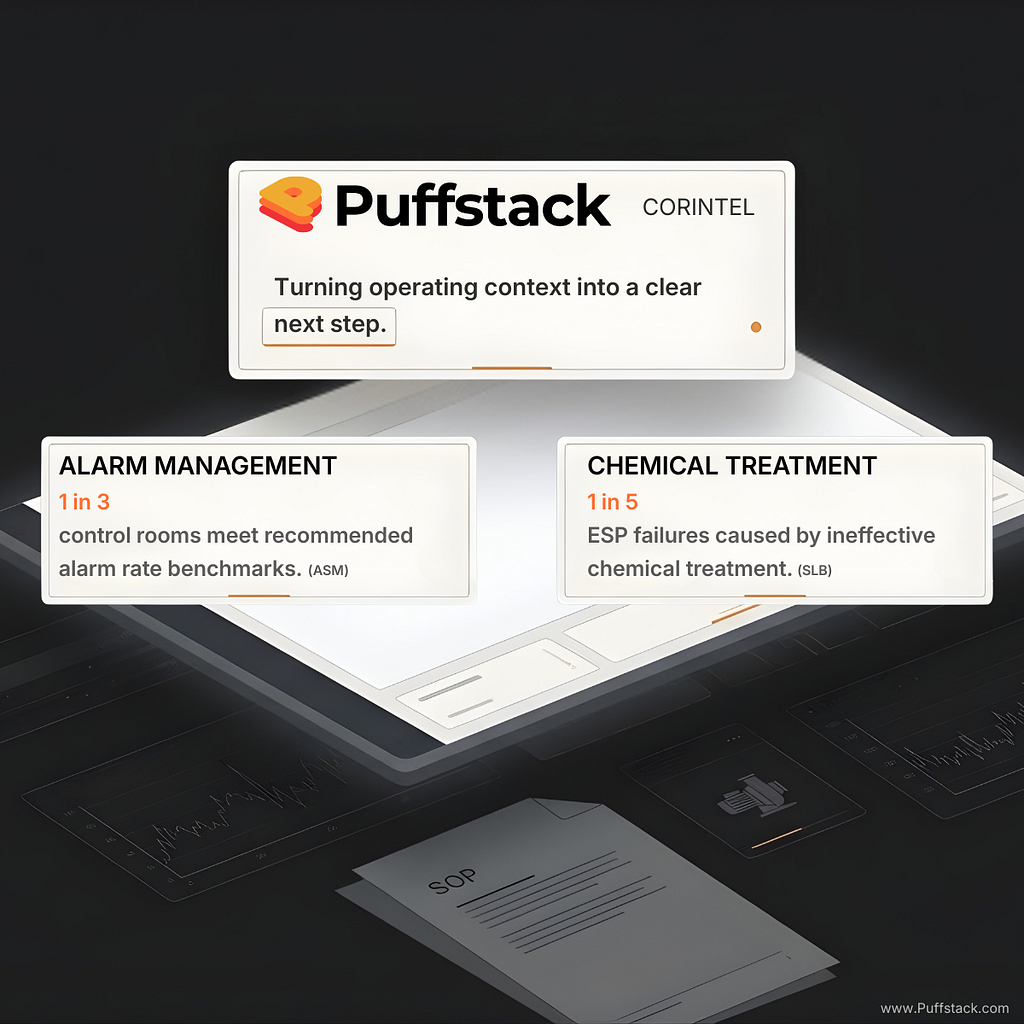
40% of chemical injection wells are over treating or under treating at any given time in a SBL case study. Manual, low-frequency dosing workflows create delays between event detection and chemical adjustment. Real-time optimization systems have shown they can improve dosing precision and reduce failures.
Baker Hughes reports that production conditions can shift daily even when chemical programs are adjusted monthly, creating persistent over- and under-injection risk. Emerson has documented cases where operators over-inject as insurance against under-treatment, at significant and often invisible cost.
The data to do better is usually present: flow rates, water cut, corrosion coupon readings, chemical inventory levels. What is missing is software that continuously interprets those operating conditions and converts them into a dosing decision the team can trust.
Alarm management
EEMUA 191 recommends fewer than one alarm every ten minutes during normal operation and fewer than ten alarms in the first ten minutes after a major upset. ASM benchmarking across 37 operator consoles found roughly one-third achieved the normal-operation target. Two consoles came close to the upset-condition benchmark.
60 to 80% of alarm occurrences typically come from a small number of bad actors: chattering, stale, duplicate, redundant, and cascading alarms. Teams are not short on raw signals. They are short on synthesis, prioritization, and systems that preserve root-cause context across shift handoffs.
From visibility to action
Industrial software that stops at visibility solves half the problem. The other half is reducing the interpretation required to move from signal to action, and over time, compressing the repetitive, low-value workflow around that decision path so experienced teams spend their energy on the exceptions that require judgment.
Corintel monitors live process conditions via OPC-UA, MQTT, or Modbus, pulls the relevant operating and maintenance context, surfaces likely causes, and supports the next action. Sometimes that means prioritizing which deviation matters first. In other cases it generates a draft response, triggers a workflow, escalates the right team, or recommends a bounded process adjustment based on historical behavior and site rules.
Better decisions, made faster, with better context, executed with less friction. That is what operational optimization looks like when the software earns the operator’s trust over time.
If your AI strategy starts with the infrastructure you already have, we should talk. www.puffstack.com